Summary
Biography
Introduction
Maricha is a key figure in the Ramayana, recognized for his cunning, mastery of magical abilities, and pivotal role in the events leading to Sita’s abduction. Though a Rakshasa allied with Ravana, Maricha is depicted as a complex character who displays intelligence, fear, and eventual repentance. His life demonstrates the interplay of power, morality, and destiny in the epic, and his actions significantly influence the unfolding of Rama’s story.
Birth and Background
Maricha was born into a lineage of powerful Rakshasas, beings endowed with supernatural strength and magical capabilities. From childhood, he was trained in the arts of warfare, sorcery, and deception, skills that would make him one of Lanka’s most feared warriors.
Despite his fearsome abilities, Maricha was known to possess moments of reflection and caution, indicating a sense of moral awareness uncommon among many of Ravana’s followers.
Abilities and Powers
Maricha was renowned for his mastery of Maya Shastra, the art of illusions, and other supernatural powers. His skills allowed him to change form, vanish at will, and create terrifying images to intimidate his enemies. These abilities made him an invaluable asset to Ravana’s campaigns against divine and mortal forces.
He was also a formidable combatant, trained in both weaponry and physical warfare. Maricha’s intelligence and magical prowess made him both feared and respected among the Rakshasas of Lanka.
Role in the Abduction of Sita
Maricha’s most significant contribution to the Ramayana occurs during Ravana’s plot to abduct Sita. Ravana, seeking to kidnap Sita from Janaka’s palace, enlisted Maricha to assist in luring Rama and Lakshmana away from Sita.
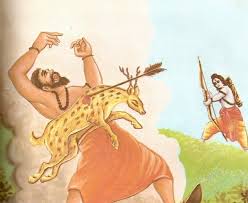
Using his mastery of illusion, Maricha transformed into a golden deer to capture Sita’s attention. The deer’s beauty and seemingly harmless nature intrigued Sita, who requested Rama to capture it. Maricha led Rama on a long chase, successfully drawing him away from the hermitage where Sita resided.
Maricha’s Realization and Fear
Unlike many Rakshasas, Maricha was aware of the dangers in opposing divine figures like Rama. While carrying out Ravana’s orders, he repeatedly warned of the potential consequences, expressing fear for his life. Despite this, he complied out of obligation, loyalty, and fear of Ravana’s wrath.
Maricha’s reluctance adds complexity to his character, portraying him not simply as an evil being but as one caught between duty, fear, and morality.
Death of Maricha
After luring Rama far from Sita, Maricha was ultimately slain by Rama with a single arrow, demonstrating the divine power of Rama and the inevitability of dharma’s triumph. In his final moments, Maricha accepted his fate and acknowledged the supremacy of Rama’s divine will.
His death, though tragic from a human or Rakshasa perspective, plays a crucial role in the epic, setting the stage for Sita’s abduction and the subsequent events of the Ramayana war.
Moral and Philosophical Significance
Maricha’s story highlights several moral and philosophical lessons:
- The consequences of serving unrighteous power: Despite his talents, his alliance with Ravana led to his downfall.
- Moral awareness amidst wrongdoing: His fear and reluctance suggest that conscience exists even in beings considered evil.
- The inevitability of dharma: Actions that oppose righteousness inevitably lead to destruction.
- The role of destiny: Maricha’s actions, though deliberate, were part of a larger cosmic plan that led to Rama’s victory.
Cultural and Literary Legacy
Maricha is remembered in literature, drama, and folklore as the Rakshasa who played a crucial, albeit tragic, role in the Ramayana. His golden deer disguise is one of the most famous episodes in the epic, often depicted in artwork, dance, and storytelling.
His character serves as a lesson in the complexities of loyalty, fear, and moral choice, and is cited in ethical discussions in classical and contemporary Indian literature.
Symbolism
Maricha symbolizes:
- Temptation and deception: His golden deer form represents illusion and the dangers of desire.
- Complex morality: Not all agents of evil are devoid of conscience or fear.
- Catalyst of destiny: His actions, though intended to aid Ravana, indirectly facilitated the unfolding of dharma.
Through Maricha, the Ramayana teaches that even flawed or reluctant participants in wrongdoing contribute to the ultimate triumph of justice.
Lessons from Maricha’s Life
- Obedience to unrighteous authority can lead to destruction.
- Fear and conscience may coexist even in beings considered evil.
- Small actions, even by minor characters, can have major consequences in the cosmic or moral order.
- Illusions and deception, though powerful, are ultimately defeated by truth and righteousness.
Conclusion
Maricha remains a significant figure in the Ramayana, embodying the themes of temptation, fear, and moral complexity. His golden deer episode is not only pivotal in the narrative but also rich in symbolism, emphasizing the interplay of dharma, destiny, and human (or Rakshasa) psychology. Though a Rakshasa, Maricha’s character provides timeless lessons about duty, fear, and the consequences of aligning with unrighteous power.