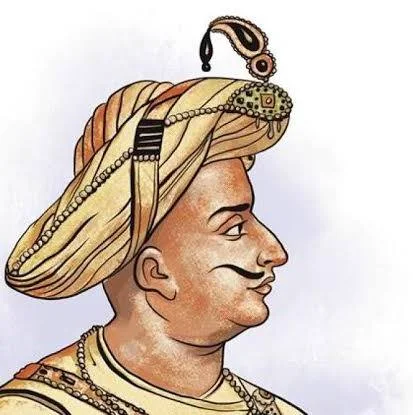
Tipu Sultan
Colonial Era | 01 December 1751 - 04 May 1799
"Tipu Sultan was the ruler of the Kingdom of Mysore from 1782 to 1799. Popularly known as the “Tiger of Mysore,” he is remembered for resisting British expansion, strengthening Mysore’s administration, and developing the military use of iron-cased rockets"
Born
01 December 1751Birthplace
Devanahalli, Kingdom of Mysore (Present-day Karnataka, India)Died
04 May 1799Place of Death
Seringapatam, Kingdom of Mysore (Present-day Srirangapatna, Karnataka, India)Nationality
IndiaGender
MaleTipu Sultan Biography
Tipu Sultan, whose full name was Sultan Fateh Ali Sahab Tipu, was the ruler of the Kingdom of Mysore from 1782 until 1799. Popularly known as the Tiger of Mysore, he became one of the most formidable opponents of the British East India Company's expansion in India. He was a skilled military commander, an ambitious administrator, and an innovator who supported the development and use of iron-cased rockets in warfare.
Early Life and Family
Tipu Sultan was born on 1 December 1751 at Devanahalli in the Kingdom of Mysore, located in present-day Karnataka. He was the son of Hyder Ali and Fatima Fakhr-un-Nisa.
His father, Hyder Ali, rose from the position of a military commander to become the ruler of Mysore. Tipu grew up during a period of intense political and military competition among Indian kingdoms, the Marathas, the Nizam of Hyderabad, and European colonial powers.
Education and Military Training
Tipu Sultan received an extensive education suitable for a prince and future ruler. He studied subjects such as Persian, Arabic, Islamic law, administration, diplomacy, military strategy, horse riding, swordsmanship, and archery.
French military officers serving Mysore also influenced his military training. Tipu accompanied his father on campaigns from a young age and gained practical experience in warfare, diplomacy, and political administration.
Early Military Career
Tipu Sultan began participating in military operations while still a teenager. He accompanied Hyder Ali during campaigns in the Malabar region and gradually acquired experience as a commander.
He later fought in conflicts involving the British East India Company, the Marathas, and other regional powers. His early campaigns established his reputation as an energetic and capable military leader.
First Anglo-Mysore War
The First Anglo-Mysore War was fought between Mysore and the British East India Company from 1767 to 1769. Tipu Sultan participated in the conflict alongside Hyder Ali.
The war demonstrated the growing military strength of Mysore and ended with the Treaty of Madras in 1769. Tipu's involvement provided him with valuable experience in dealing with British forces and their regional allies.
Second Anglo-Mysore War
The Second Anglo-Mysore War began in 1780. During the conflict, Tipu Sultan commanded Mysorean forces in several important engagements.
The Battle of Pollilur in 1780 became one of the most notable Mysorean victories over the British East India Company. Mysore's cavalry, artillery, and rocket units contributed significantly to the defeat of the British force commanded by Colonel William Baillie.
Tipu continued directing military operations following the death of his father in 1782.
Accession to the Throne
Hyder Ali died in December 1782 during the Second Anglo-Mysore War. Tipu Sultan succeeded him as the ruler of Mysore and continued the campaign against the British.
The conflict ended with the Treaty of Mangalore in 1784. The treaty restored territories captured by both sides and temporarily brought peace between Mysore and the British East India Company.
Administration and Governance
Tipu Sultan introduced several administrative reforms designed to strengthen the Mysore state. He reorganized provincial administration, improved revenue collection, regulated trade, and sought to increase the authority of the central government.
His administration maintained detailed records and appointed officials to supervise different regions and departments. Tipu also introduced new systems of weights, measures, coinage, and calendars.
These measures were intended to improve administrative efficiency and establish Mysore as a powerful, centralized kingdom.
Economic Policies
Tipu Sultan understood that economic strength was essential for political and military independence. His government supported agriculture, irrigation, trade, manufacturing, and state-controlled industries.
He encouraged the production of silk, sugar, sandalwood, spices, textiles, weapons, and other valuable goods. The Mysore state established trading centers and attempted to develop commercial relations with foreign countries.
Tipu sought to reduce Mysore's dependence on European-controlled trade and increase the kingdom's economic self-sufficiency.
Mysorean Rockets
One of the most important military developments associated with Tipu Sultan was the improvement and organized deployment of Mysorean rockets.
Unlike many earlier rockets, Mysorean rockets used iron tubes to contain the propellant. The iron casing enabled the rockets to travel farther and carry more powerful explosive charges.
Specialized rocket units were included in the Mysorean army. These weapons were deployed against British forces during the Anglo-Mysore Wars and influenced the later development of the British Congreve rocket.
Military Organization
Tipu Sultan worked to modernize the Mysorean army by adopting new weapons, training methods, defensive systems, and military organization.
His forces included:
- Infantry trained in contemporary military methods.
- Cavalry units used for rapid movement and battlefield attacks.
- Artillery equipped with cannons and other weapons.
- Specialized units trained to operate Mysorean rockets.
- Fortified defensive positions protecting important cities and routes.
Tipu also sought technical and military cooperation from France and other foreign powers to counter British influence.
Diplomatic Relations
Tipu Sultan maintained diplomatic relations with several foreign rulers and governments. He sent representatives to France, the Ottoman Empire, Afghanistan, and other regions in search of commercial and military cooperation.
His foreign policy was largely shaped by the need to resist the growing influence of the British East India Company in southern India.
Third Anglo-Mysore War
The Third Anglo-Mysore War began in 1790 after conflict between Mysore and Travancore. The British East India Company formed an alliance with the Marathas and the Nizam of Hyderabad against Tipu Sultan.
Facing this combined coalition, Tipu defended Mysore through a series of military campaigns. British-led forces eventually advanced toward Srirangapatna, the capital of Mysore.
The war ended with the Treaty of Seringapatam in 1792. Under its terms, Tipu was forced to surrender approximately half of his territory to the victorious alliance. Two of his sons were temporarily handed over as hostages to guarantee compliance with the treaty.
Rebuilding Mysore
After the Third Anglo-Mysore War, Tipu Sultan attempted to rebuild the kingdom's military and economic strength. He repaired defensive structures, reorganized his forces, and continued seeking international alliances.
The British viewed these diplomatic and military efforts as a continuing threat to their ambitions in southern India.
Fourth Anglo-Mysore War
The Fourth Anglo-Mysore War began in 1799. The British East India Company and its allies launched a major campaign against Mysore and advanced toward Srirangapatna.
Tipu Sultan personally participated in the defense of his capital. Despite determined resistance from Mysorean forces, the British-led army breached the city's defenses on 4 May 1799.
Death at Srirangapatna
Tipu Sultan was killed on 4 May 1799 while defending Srirangapatna during the final assault of the Fourth Anglo-Mysore War. He was forty-seven years old.
His body was discovered near the Water Gate of the fortified city after the battle. He was buried at the Gumbaz mausoleum in Srirangapatna beside the graves of his father, Hyder Ali, and his mother, Fatima Fakhr-un-Nisa.
The Title Tiger of Mysore
Tipu Sultan became widely known as the Tiger of Mysore. The tiger served as an important personal and royal symbol during his reign.
Tiger motifs appeared on his throne, weapons, uniforms, coins, and other royal objects. The symbol represented strength, authority, determination, and resistance against his enemies.
One of the most famous surviving objects associated with him is Tipu's Tiger, a mechanical wooden figure now held by the Victoria and Albert Museum in London.
Architecture and Cultural Contributions
Tipu Sultan supported the construction and renovation of palaces, forts, mosques, roads, gardens, and administrative buildings.
Important monuments connected with him include:
- Daria Daulat Bagh, his summer palace at Srirangapatna.
- Gumbaz, the mausoleum containing the tombs of Tipu Sultan and his parents.
- Srirangapatna Fort, the principal defensive center of his capital.
- Jama Masjid at Srirangapatna.
These monuments remain important examples of Mysorean art, architecture, and history.
Historical Debate
Tipu Sultan's legacy has been interpreted differently by historians and communities. He is admired for resisting British expansion, modernizing the Mysorean military, and strengthening the administration and economy of his kingdom.
At the same time, aspects of his military campaigns and policies in regions such as Malabar, Kodagu, and Mangalore remain subjects of historical debate. Some accounts describe coercive measures and forced displacement, while other studies emphasize the political and military circumstances of the period.
A balanced understanding of Tipu Sultan requires careful examination of inscriptions, administrative records, correspondence, regional histories, and later interpretations.
Legacy
Tipu Sultan remains one of the most prominent rulers of eighteenth-century India. His determined resistance prevented the British East India Company from easily establishing control over Mysore during his lifetime.
His military innovations, diplomatic initiatives, economic policies, and death in battle made him a powerful symbol of resistance to colonial expansion.
The fall of Srirangapatna in 1799 significantly strengthened British power in southern India and marked a major turning point in the political history of the subcontinent.
Honours and Recognition
- Remembered as the Tiger of Mysore.
- Ruler of the Kingdom of Mysore from 1782 to 1799.
- Known for resistance against the British East India Company.
- Associated with the development and use of iron-cased Mysorean rockets.
- Died defending Srirangapatna during the Fourth Anglo-Mysore War.
- Recognized as one of the most significant rulers of eighteenth-century India.
Conclusion
Tipu Sultan was a courageous military commander, ambitious administrator, and determined ruler who devoted his reign to strengthening Mysore and resisting British expansion. His use of advanced military technology, economic reforms, international diplomacy, and final defense of Srirangapatna secured his place in Indian history. Although interpretations of his rule remain complex and debated, his importance in the political and military history of eighteenth-century India is undeniable.
Comments & Tribute (0)