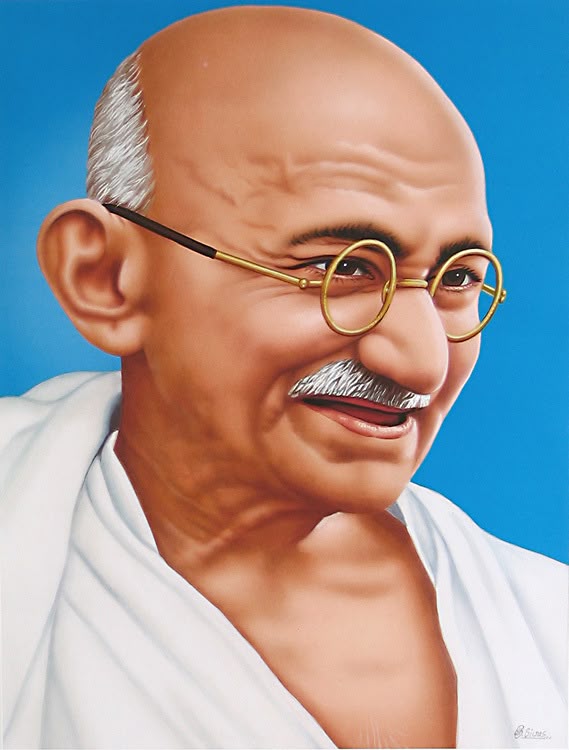
Mahatma Gandhi
Freedom Fighters | 02 October 1869 - 30 January 1948
"Mahatma Gandhi was the leader of India's nonviolent independence movement against British rule. Known as the "Father of the Nation," he inspired millions through his principles of truth, peace, and civil disobedience, leaving a lasting impact on civil rights movements worldwide."
Born
02 October 1869Birthplace
Porbandar, Kathiawar Agency, British India (Present-day Gujarat, India)Died
30 January 1948Place of Death
Birla House, New Delhi, IndiaNationality
IndianGender
MaleMahatma Gandhi Biography
Mahatma Gandhi, born as Mohandas Karamchand Gandhi on 2 October 1869 in Porbandar, Gujarat, was one of the most influential leaders in world history. He played a crucial role in India's struggle for independence from British rule through his philosophy of nonviolence and truth. Revered as the "Father of the Nation" in India, Gandhi's teachings continue to inspire movements for civil rights and freedom across the globe.
Early Life and Education
Gandhi was born into a Hindu family. His father, Karamchand Gandhi, served as the Diwan (Chief Minister) of Porbandar, while his mother, Putlibai, was deeply religious and influenced Gandhi's moral values. He completed his early education in Rajkot and later traveled to London in 1888 to study law at the Inner Temple.
After successfully qualifying as a barrister, Gandhi returned to India in 1891. However, finding limited opportunities in India, he accepted a legal assignment in South Africa in 1893, a decision that would transform his life forever.
Struggle in South Africa
While living in South Africa, Gandhi experienced racial discrimination firsthand. One notable incident occurred when he was thrown out of a first-class railway compartment despite holding a valid ticket. This event deeply impacted him and motivated him to fight against injustice.
During his 21 years in South Africa, Gandhi developed the philosophy of Satyagraha, meaning "truth-force" or "soul-force." Through peaceful protests and civil disobedience, he successfully campaigned for the rights of Indians living there.
Return to India and Freedom Movement
Gandhi returned to India in 1915 and soon became a prominent leader in the Indian National Congress. He traveled extensively throughout the country to understand the challenges faced by ordinary Indians.
He led several significant movements against British rule, including:
- Champaran Satyagraha (1917) - Support for indigo farmers in Bihar.
- Kheda Satyagraha (1918) - Protest against unfair taxation in Gujarat.
- Non-Cooperation Movement (1920-1922) - Encouraged Indians to boycott British institutions.
- Dandi Salt March (1930) - A historic protest against the British salt tax.
- Quit India Movement (1942) - A nationwide call demanding immediate independence.
Philosophy of Nonviolence
Gandhi strongly believed that violence could never bring lasting peace. His principles of Ahimsa (nonviolence) and Satyagraha (truth) formed the foundation of his political and social movements. He encouraged people to resist oppression peacefully while maintaining respect for their opponents.
His ideas later influenced global leaders such as Martin Luther King Jr., Nelson Mandela, and the Dalai Lama.
Social Reforms
Beyond politics, Gandhi worked tirelessly to improve Indian society. He campaigned against untouchability, promoted education, encouraged rural development, and advocated for women's rights. He also emphasized self-reliance through the use of khadi (hand-spun cloth) and village industries.
Role in India's Independence
Gandhi's leadership united millions of Indians in the struggle for freedom. Through peaceful demonstrations, boycotts, and mass movements, he challenged British colonial rule and inspired people from all backgrounds to participate in the independence movement.
India finally achieved independence on 15 August 1947, marking the realization of a dream Gandhi had pursued for decades.
Assassination and Death
On 30 January 1948, Mahatma Gandhi was assassinated by Nathuram Godse while attending a prayer meeting at Birla House in New Delhi. His death shocked the nation and the world.
His final words are widely believed to have been "Hey Ram."
Legacy
Mahatma Gandhi remains a symbol of peace, truth, and nonviolent resistance. His birthday, 2 October, is celebrated as Gandhi Jayanti in India and recognized globally as the International Day of Non-Violence.
His teachings continue to inspire people to fight injustice through peaceful means, making him one of the most respected figures in modern history.
Conclusion
Mahatma Gandhi's life was dedicated to truth, justice, and the welfare of humanity. Through courage, determination, and unwavering commitment to nonviolence, he helped India achieve independence and left behind a timeless legacy that continues to guide generations across the world.
Comments & Tribute (0)